
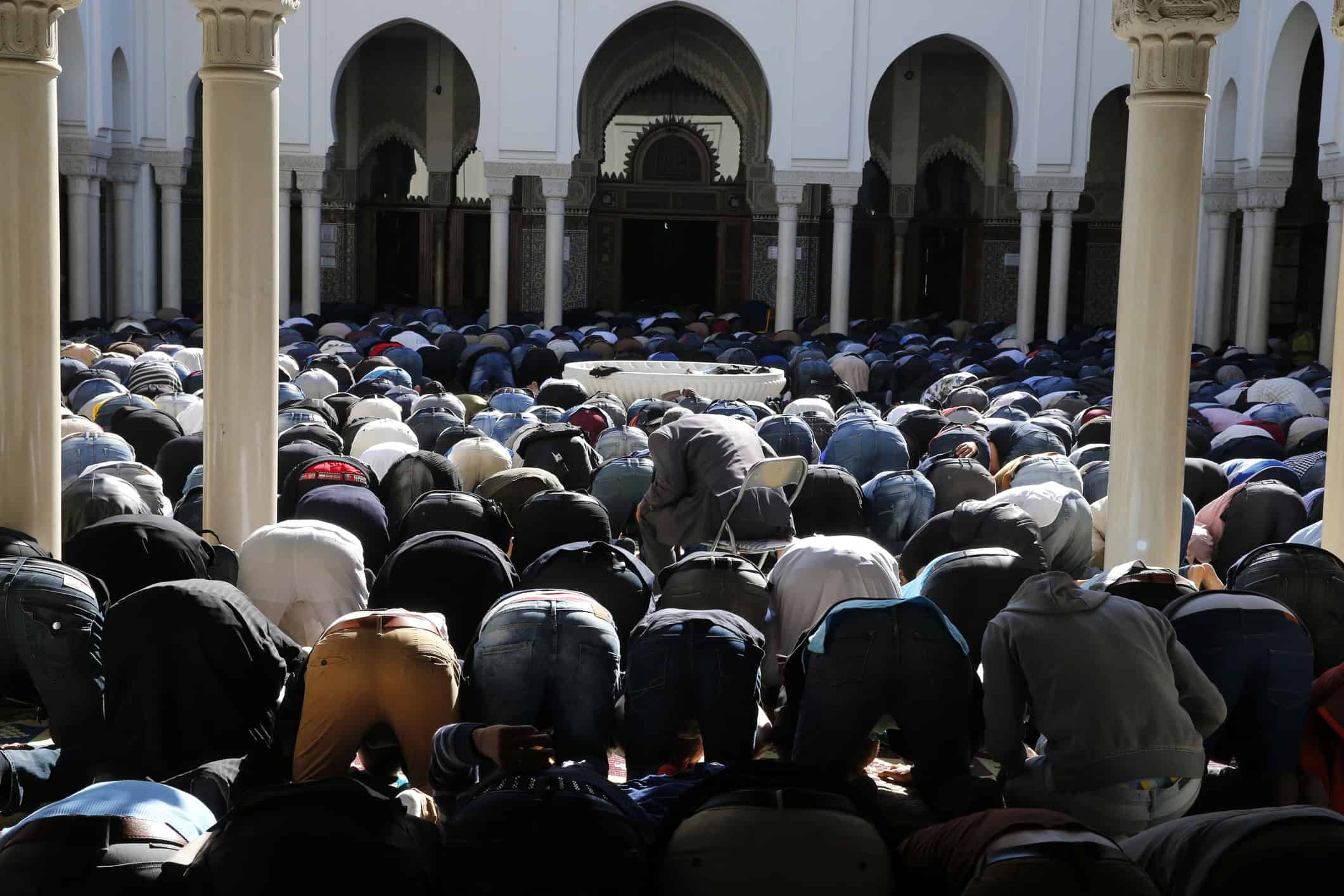
How Islam is building dar al-Islam inside the West
Europe still looks for armies at the border. It gets nervous at Russian aggression and rearms against the threat of drones and tanks. But Europe does not know how to recognize the threat that it is facing – a conquest conducted through settlement, institutions, religious authority, political organization, and time.
The old rules were easy to understand, armed men in uniform crossing defined borders. Cities fall. Laws change. A ruler claims a territory and maintains that position through their ability to defend it.
What is happening to Europe today is obvious to the whole world. How it is happening has become almost invisible because each individual action hides itself under the aegis of the moral and legal order that the West is desperate to cling to.
Migrants settle. Families grow. Mosques are built. They acquire schools, charities, businesses, media platforms, marriage councils, welfare networks, and political organizations. Population becomes permanence. Permanence becomes institutional power. Institutional power becomes social authority. Social authority becomes political control.
No single moment looks like conquest. Yet the completed structure performs many of conquest’s historical functions without a battle ever taking place.
In the West, we can’t seem to name what we are seeing. It is so foreign to our way of thinking that the best we can do is to land on terms like “Illegal immigration” because immigration is the last stage in the process that is familiar, and the “Illegal” part is the only violation we can see.
Sure, Immigration describes people entering a country. But it says nothing about the power built after they arrive. It fails to describe the conversion of population into a permanent religious order with its own authorities, laws, institutions, sources of finance, systems of education, political representatives, and territorial concentrations.
We do have a word for what we’re seeing, and that word is Colonization.
Colonization is the deliberate creation of durable collective power in territory through settlement, reproduction, institutional construction, and an expanding capacity to shape the surrounding political order. That is what Islamic movements are doing throughout the Western world. The system is larger than any single movement. The Muslim Brotherhood provides its most sophisticated political method. Al-Azhar, transnational jurists, fatwa councils, mosques, Islamic schools, foreign states, charities, satellite broadcasters, and digital preachers provide different forms of authority and support. Salafist currents reinforce social separation. Qatar and Turkey provide finance, logistics, media, or political protection. Local activists convert the resulting population into electoral leverage.
Of course, our Western liberal instinct is to reach for “Not all Muslims”. Those who might challenge that assertion are usually labeled “Islamophobes”. This of course ignores the nature of Islam and why the process is effective.
The process doesn’t depend on what the average Muslim privately believes. It doesn’t need “all Muslims”.
Islam is a top-down political and normative coordination model. Its scholars define law. Its religious institutions authorize conduct. Its preachers transmit doctrine. Its schools reproduce identity. Its communal organizations discipline dissent. Its political movements convert religious belonging into collective power. A population can participate in the expansion of this system without understanding its total architecture, just as populations throughout history have lived inside political orders they did not design.
This is the point that has blinded the West.
Western analysis repeatedly asks whether most Muslims support terrorism, belong to the Muslim Brotherhood, or consciously intend to conquer Europe. These are evasive questions. A movement does not need a majority of ideological cadres. It needs authoritative institutions capable of organizing a much larger population. Nor does conquest require terrorism. The Brotherhood’s great political innovation was to understand that Western freedoms could make violence unnecessary. The mosque, school, charity, pressure group, television network, courtroom, and ballot box could achieve what no army could.
The question we must examine is therefore far more direct, and far more consequential: have pockets of dar al-Islam already been acquired inside the West?
If dar al-Islam is defined exclusively as a sovereign Muslim state applying Islamic public law, the answer is no. If it includes territory in which Islam possesses security, permanent institutions, public authority, and the practical ability to regulate the lives of Muslims, the answer is yes. Britain, France, Sweden, and other Western countries now contain localities in which Islamic institutions exercise forms of normative and political control that Western governments retain in law but no longer monopolize in practice.
These are functional colonies without governors, acquisitions without treaties, and frontiers that do not appear on a map.
The willful blindness of Europe
Dar al-Islam means the domain or abode of Islam. Muslim jurists developed the category to distinguish lands governed by Islam, lands outside Islamic rule, and the legal obligations that followed from living in each. The Quran does not supply one constitutional definition, and jurists disagreed over the decisive criteria. Some emphasized Muslim sovereignty and the operation of Islamic law. Others emphasized the security of Muslims, their freedom to practise Islam publicly, or the persistence of Islamic rules and institutions after a non-Muslim power took control.
The disagreement is routinely used to dismiss the category and any concerns associated with it.
But a doctrine does not have to be unanimous to organize political action. Christianity, socialism, nationalism, and liberalism have all produced rival schools while retaining immense political force. What matters is which interpretation institutions teach and apply.
The looser definitions of dar al-Islam are especially important in the West. Jasser Auda, a contemporary scholar of Islamic law, argues that Muslim security and freedom to practise the public signs of Islam are central criteria. By those measures, Western countries can rank highly on a “Land of Islam” scale (Auda 2018). The argument is presented as adaptation. Its territorial implication is profound. A non-Muslim state can become Islamic space because its own freedoms protect the institutions through which Islam establishes itself.
The International Islamic Fiqh Academy gave that logic an institutional program in 2006. It permitted Muslims outside Muslim-majority countries to participate in social, political, and economic life. It also directed them toward sharia in personal and family disputes through Islamic arbitration or binding fatwa. It urged Muslim states to strengthen the “Islamic existence” of Muslims abroad by supporting schools, colleges, religious institutes, and trained preachers (International Islamic Fiqh Academy 2006).
It’s important to recognize that this isn’t a doctrine of personal belief or worship, it is a blueprint for permanent Islamic infrastructure under non-Muslim sovereignty. Citizenship provides protection and political access. Islamic law retains authority over intimate life. External Muslim power supports the institutions. The population becomes rooted while its religious organization remains transnational. Importantly this ruling makes explicit the primacy of Islamic law, “ In Fatwā issuance, there must be no exceptions for Muslims in non-Muslim countries except in case of necessity, dire general need that creates.”
Al-Azhar uses the language of citizenship and integration. Its Grand Imam tells European Muslims that full citizenship is compatible with preserving Islamic identity. Egypt’s Dar al-Ifta permits citizenship in non-Muslim states and supplies rulings for Muslims living there (Al-Azhar Observatory 2020; Dar al-Ifta 2025). Western readers hear accommodation. They miss the political structure. The individual becomes a citizen of Britain or France while remaining subject to an Islamic normative order whose authorities, sources, and civilizational frame extend beyond Britain or France.
This dual structure is the foundation of the modern expansion. It does not require Muslims to reject citizenship. It teaches them how to use citizenship, and it teaches Islamic movements how to weaponize the citizenship of Muslims irrespective of their personal views.
More than a religion
The conversation in the West is trapped between two inaccurate conceptions of Islam. One sees Islam as an ethnicity and therefore regards criticism of Islamic doctrine as racism or “Islamophobia”. The other sees Islam as a private faith comparable to a modern European denomination whose political claims have become incidental. The reality is that Islam is neither an ethnicity nor a collection of private devotional beliefs. It is a religious civilization with legal, political, social, and territorial traditions and ambitions of global conquest.
That doesn’t mean that every Muslim studies classical jurisprudence or supports an Islamic state. Political systems don’t depend on universal doctrinal literacy. The average British citizen has never read Locke, Dicey, or the constitutional statutes that structure British government. Yet their “British values” carry the legacy of all three.
Islam operates in the same way. The Quran and prophetic tradition supply foundational authority. Jurists turn authority into rules. Schools of law organize interpretation. Religious institutions train scholars. Mosques and preachers transmit rulings. Families and communal networks normalize conduct. Islamic organizations defend the resulting practices. Political movements aggregate them into demands. Muslim states finance selected institutions and use religious legitimacy to project power abroad.
There is no pope and no single Islamic government. Decentralization does not mean absence of hierarchy. Authority is distributed among scholars, institutions, states, movements, and reputational networks. Rulings compete, but ordinary believers do not approach the field as isolated philosophers. They rely on authorities whose credentials have already been recognized by other authorities.
This arrangement is especially effective in the diaspora. A believer in Bradford can receive a fatwa from Cairo, listen to a Qatari-backed broadcaster, follow a preacher trained in Medina or Istanbul, donate to an international Islamic charity, send children to a local Islamic school, seek a religious divorce from a British sharia council, and vote according to a campaign organized through a mosque network. No central controller has to issue one instruction linking these acts. Instead, each institution can leverage the faithful.
The phrase “top down” therefore does not mean mechanically centralized. It means that doctrine, legitimacy, leadership, and acceptable communal conduct are produced through an authority structure rather than being invented independently by each believer. The political effect can be coordinated even where the organizations compete.
Western officials are trained to detect conspiracies, registered memberships, financial transfers, and direct orders. They are less capable of detecting a system whose coordination is doctrinal and institutional. When investigators fail to find a single command center, they often conclude that the pattern is a coincidence, or worse they actively determine each vector to be separate, thereby minimizing the whole. This is like denying the existence of a free market because there is nobody in charge of setting the price.
Once the system reaches a certain scale it has its own feedback loops. Greater population supports more mosques and schools. More institutions create more religious professionals. Those professionals define communal interests. Communal organizations gain recognition from government. Recognition brings money and access. Money expands the institutions. Political concessions demonstrate the value of collective organization and increase the authority of the leaders who obtained them.
Each success strengthens the machinery that produces the next demand.
Of course, to reach this scale, the systems need to be seeded, which we will discuss in a later section.
All of this is also why Islamic moderation cannot be measured solely by the rejection of violence. A religious authority may condemn terrorism while insisting that divine law is superior to man-made law, that Muslims should preserve a separate collective identity, that family life should remain under sharia, and that public institutions must accommodate Islamic norms. From the standpoint of public safety, he is nonviolent. From the standpoint of territorial and political transformation, he may be highly effective.
The West made violence its threshold because violence is easy to criminalize. The West also created protections around everything that doesn’t meet that threshold which in turn became a systemic vulnerability which could be exploited by Gradual Islamization.
What does Dar-al-Islam look like?
Territorial acquisition usually evokes ownership or sovereignty. A state acquires land through conquest, treaty, purchase, annexation, or secession. That legal definition is too narrow for the process occurring inside Western states.
Territory is also the space within which an authority makes its rules effective. A government proves sovereignty through courts, police, taxation, and administration. A communal order proves authority through education, marriage, welfare, reputation, exclusion, religious status, and the capacity to organize collective action. The two forms can occupy the same geography.
The Islamic pocket is therefore nested. British or French law controls the outer shell. Islamic authority governs increasing portions of the inner life. The outer sovereign may even protect the inner order through religious-freedom law, equality rules, grants, policing policy, and official consultation.
Acquisition occurs when the Islamic order becomes durable enough to survive individual leaders and strong enough to impose costs on those who leave it. The crucial tests are concrete:
- Who determines whether a marriage is valid or dissolved in practice?
- Who controls the moral and religious education of children?
- Who can define a speaker, book, teacher, or candidate as hostile to the community?
- Who distributes charity, introductions, employment, and social status?
- Who negotiates with police, schools, councils, and political parties?
- Who can mobilize votes or demonstrations?
- Who decides which Muslim voices government will recognize?
- Can an individual reject the religious order without losing family, livelihood, safety, or belonging?
Where national law supplies one answer but lived reality supplies another, sovereignty has divided.
This is not a speculative future threshold. The British evidence shows it in marriage and education. The French evidence shows it in municipal ecosystems. The American evidence shows how concentrated votes can convert communal morality into official policy. These are acquisitions of function before acquisitions of constitutional form.
The word “pocket” does not imply a hermetically sealed district. Modern power operates through networks as much as through contiguous borders. A mosque, school, charity, media platform, property portfolio, and political association can govern a shared population even when the buildings are separated by streets controlled by the state. The territorial element comes from population concentration and the local effectiveness of the network.
The result resembles an archipelago. Each island remains formally part of the national territory. The institutions linking the islands create a parallel political geography that national maps do not display.
Islam never forgets
Islamic territorial thought carries a memory that modern Western states have largely abandoned. Western empires withdrew from most of the territories they ruled. Their former colonies became sovereign states, and few Europeans believe that withdrawal made those lands eternally Western. Islamic political memory contains a different possibility: land incorporated into the Islamic world can retain a sacred or civilizational status after Muslim rule ends.
Al-Andalus is the great symbol. Muslim armies entered Iberia in 711. Muslim polities ruled all or part of the peninsula for centuries until Granada surrendered in 1492. The period produced conquest, hierarchy, cultural brilliance, religious coexistence, persecution, civil war, and eventual Christian reconquest. Modern Islamist and jihadist rhetoric extracts a political memory from that history. Córdoba and Granada become symbols of a lost Islamic possession and of a civilizational frontier that history has not finally closed.
This does not mean that every Muslim believes Spain must be reconquered. That is another irrelevant majoritarian test. The question is whether authoritative movements preserve and activate the claim. Al-Qaeda did so violently. Gradualist Islamists do so through memory, da’wa, settlement, and institutional permanence. The methods differ. The map survives.
Classical jurists disputed whether land ceased to be dar al-Islam when non-Muslims conquered it. Debates over India, Sicily, Iberia, and other lost territories turned on whether Muslims retained security, public worship, and Islamic legal life. That inheritance supplies modern movements with more than nostalgia. It supplies a vocabulary in which territorial status can survive political defeat and return through renewed Islamic establishment.
This is the point at which modern migration intersects with premodern doctrine. Western Europe has allowed millions of Muslims to settle permanently, reproduce, build religious institutions, and exercise political rights. Under a Western description, they have joined secular nation-states. Under an Islamic territorial description, Islam has acquired secure populations and permanent institutions in lands it did not conquer militarily.
The two descriptions can refer to the same facts. Only one sees their direction.
The power of population
Postwar Muslim migration to Europe was not organized as one religious invasion. Britain recruited labour from South Asia and former colonies. France received workers and families from North and West Africa. Germany recruited Turks. Governments expected much of the migration to be temporary. Migrants often did as well.
The temporary became permanent. Men brought wives. Children were born. Prayer rooms became mosques. Mosques became institutional centers. Commerce adapted. Religious authorities arrived or were trained. Foreign governments and transnational movements recognized the opportunity.
Pew estimated that Muslims comprised 4.9 percent of the population of the European Union, Norway, and Switzerland in 2016. Even if migration stopped completely, it projected that the share would rise to 7.4 percent by 2050 because Muslims were younger and had higher fertility than the non-Muslim population. Continued migration generated higher scenarios (Pew Research Center 2017).
This destroys the fantasy that border control alone can end the transformation. The population is now internal, permanent, and increasingly native-born. New migration expands the settlement, but reproduction sustains it. Islamic institutions then convert demographic continuity into collective power.
The private motive of each parent does not determine the political result. Families produce children. Institutions educate them. Religious authorities define legitimate conduct. Communal networks shape marriage, friendship, employment, charity, and reputation. Political organizations aggregate the population. What begins as millions of private choices becomes a public bloc through top-down coordination.
Western polling asks the population what it believes and then mistakes the answers for the structure of power. British Muslims often report strong attachment to Britain and overwhelming rejection of terrorist violence. They also hold markedly more conservative views than the surrounding population on sexuality, family, religious authority, and public morality (Ipsos MORI 2018). None of this determines whether colonization is occurring. Terrorism is not the mechanism. Personal patriotism does not dissolve institutional Islam. A person can feel British, reject bombing, vote in elections, and still submit family life to sharia authority, educate children in an Islamic system, accept religious leaders as communal representatives, and support policies that enlarge Islamic space.
The average believer does not have to coordinate the system because the system coordinates the believer.
The quiet conquest of the Brotherhood
The Muslim Brotherhood supplies the clearest political method for this environment. Hassan al-Banna founded it in Egypt in 1928 as a movement of comprehensive Islamic renewal. The sequence ran from the individual to the family, from the family to society, and from society to the state. Schools, welfare, preaching, professional networks, and disciplined organization were not secondary activities. They were the road to political power.
The Brotherhood learned that the path could change with the environment. Where violence was costly, it used gradualism. Where parties were permitted, it entered politics. Where formal membership created suspicion, it operated through public-facing organizations and ideological affiliates. Where Western officials demanded representatives of “the Muslim community,” it supplied them.
The British government’s 2015 Muslim Brotherhood Review described the movement as deliberately opaque and historically secretive. It concluded that the Brotherhood generally preferred nonviolent incremental change, often on the assumption that political opposition would disappear when Islamization was complete. It found that Brotherhood-associated organizations had operated in Britain and elsewhere in Europe for more than fifty years (United Kingdom 2015, 5).
The British development followed a revealing sequence. Early members expected to return to Muslim countries and concentrated on recruitment, study circles, and overseas causes. In the late 1980s and 1990s, Brotherhood actors adopted domestic engagement. One stated aim was to preserve the autonomy of Muslim communities in Britain. They established public-facing national organizations without openly identifying them as Brotherhood bodies. According to the government review, Brotherhood actors shaped the Islamic Society of Britain, dominated the Muslim Association of Britain for a period, helped establish and run the Muslim Council of Britain, promoted candidates, and obtained dialogue with government (United Kingdom 2015, 5–6).
The absence of one British commander did not prevent coordination. This is where Western investigators repeatedly impose the wrong model. They look for a corporate headquarters issuing orders. Islamic power can coordinate through common doctrine, overlapping personnel, religious authority, shared institutions, foreign funding, common grievances, and replicated methods. A network does not become imaginary because its control is distributed.
The achievement was representative capture. Brotherhood-linked actors acquired the ability to define Muslim interests to the government and define the government to Muslims. A small ideological cadre gained political weight from a population far larger than its membership.
France’s 2025 report on the Muslim Brotherhood and political Islam describes the next stage. It identifies local Islamist ecosystems built around mosques and connected to schools, Quran classes, charities, welfare, sport, commerce, digital preaching, and municipal politics. These networks do not always remain under direct Brotherhood command. Some become local baronies. Some hybridize Brotherhood political methods with Salafist social discipline. The ecosystem continues reproducing Islamic power even when the founding movement loses direct control (France, Ministry of the Interior 2025, 48–52).
This is how colonization becomes durable. The founding cadre can disappear. The institutions remain.
The states behind the movement
Islamic expansion in the West is not financed or directed from one capital. It is supported by competing Muslim states that understand diaspora institutions as instruments of influence.
Qatar gave Yusuf al-Qaradawi an international platform and made Al Jazeera a central instrument of state power. Qaradawi helped develop the jurisprudence of Muslim minorities and supplied religious guidance for permanent Muslim life in the West. Al Jazeera supplied the civilizational narrative. Controversies in France, Britain, Palestine, or the United States could be presented as episodes in one global drama of Muslim victimhood and resistance. Scholarship on Al Jazeera’s treatment of the French veil controversy shows how broadcasting helped construct a transnational Muslim public in Europe (Cherribi 2006).
Turkey built its own religious and political networks through state-linked institutions and provided logistical support to Brotherhood circles. Gulf money financed mosques, schools, institutes, and charities. These states do not agree on every doctrine or faction. Their competition often deepens Islamic infrastructure because each builds institutions capable of carrying its influence.
The result is a system of external support that Western law frequently misclassifies as philanthropy, religious freedom, or cultural exchange. Money becomes property. Property becomes permanence. Religious personnel become authority. Media becomes common consciousness. The foreign state acquires influence, while the Islamic institutional field as a whole becomes harder for the host society to assimilate or dismantle.
Al Jazeera is especially important for non-Arabic-speaking Muslims because its English-language operation translates Middle Eastern political frames into the language of Western public debate. It need not issue commands. It establishes salience, heroes, grievances, and the boundaries of legitimate Muslim opinion. A local dispute can be inserted into a global narrative before national institutions have understood what happened.
The movement is local in organization and transnational in consciousness. That combination is more resilient than conventional foreign control.
The institutional chain
The expansion becomes easier to see when its institutions are read as a chain rather than as unrelated expressions of diversity.
The mosque is the anchor. It supplies sacred legitimacy, regular assembly, leadership, fundraising, and access to families. A mosque may do nothing more political than serve worshippers. In an Islamist ecosystem it becomes the center from which other functions grow.
Education secures succession. Weekend Quran classes establish religious literacy and obedience. Full-time schools can shape curriculum, peer groups, dress, gender expectations, history, and the child’s understanding of the surrounding society. Training institutes produce the next generation of imams, teachers, and activists. Control of education means the movement does not have to reconvert every generation. It inherits one.
Charity creates both genuine welfare and institutional dependence. Food, housing assistance, legal help, burial support, family counseling, and emergency funds meet needs that the state fails to meet. The institution that solves a family’s problems earns trust far beyond the monetary value of the service. It also learns who is vulnerable, who is influential, and which grievances can mobilize the community.
Religious adjudication translates doctrine into lived authority. Marriage and divorce are especially important because they control family formation. A council does not need legal jurisdiction if communal recognition is more important to the parties than a civil certificate. The authority to recognize marriage determines who can form a legitimate family inside the community.
Commerce turns religious concentration into daily social territory. Halal suppliers, restaurants, clothing stores, financial services, travel businesses, publishers, property companies, and professional networks allow more of life to take place inside the communal environment. Economic density supports religious density, and both reduce dependence on the surrounding culture.
Media supplies a common interpretation. The believer encounters events not as separate disputes over a school, a cartoon, a war, a veil, or a police action, but as evidence of a continuous struggle between Islam and hostile power. Once that frame is established, local Islamic leaders can present every demand as defense rather than expansion.
Political organizations complete the chain. They register voters, endorse candidates, organize meetings, lobby institutions, file litigation, monitor speech, and punish officials who refuse accommodation. Their power comes from presenting a diverse population as a coherent constituency. Government rarely knows whether the organization represents the community. It knows only that the organization can mobilize, complain, litigate, and generate headlines.
Property makes the achievement permanent. A rented prayer room can disappear. A mosque complex, school, housing development, endowment, or commercial portfolio survives leadership changes and political controversy. Land converts a movement from an association into a territorial fact.
This chain explains why looking at any component alone produces a false sense of normality. Each institution has an innocent analogue. Their integration is the source of power.
The capture of representation
The most consequential Western concession was the decision to recognize organized Islam as the authentic voice of Muslims.
Governments wanted convenient interlocutors. They needed partners for policing, counter-extremism, integration, education, foreign policy, and community tensions. Secular citizens did not arrive with an institution claiming authority over everyone who shared their background. Islamists did.
The asymmetry rewarded ideology. A Muslim who regarded religion as private spoke only for himself. An Islamist with a council, association, mosque network, mailing list, and media operation claimed to speak for a community. Officials selected the organized actor because it appeared useful. Selection transformed the claim into reality.
Once recognized, the organization acquired access to ministers, police, civil servants, journalists, and public funds. It could define which issues counted as Muslim issues and which Muslim voices counted as legitimate. It could portray internal dissent as betrayal or inauthenticity. The state had effectively delegated part of its relationship with individual citizens to a religious intermediary.
This is colonial administration turned inside out. Historical empires often ruled through selected communal leaders. Modern European states now allow selected communal leaders to bargain upward on behalf of populations below them. The broker gains power in both directions. He tells the state that only he can deliver calm, votes, or cooperation. He tells the population that only he can secure recognition and protection.
The arrangement is self-reinforcing. Every official meeting proves the broker’s status. Every grant expands his organization. Every media appearance helps him define the community. Every government concession demonstrates that collective religious pressure works.
Brotherhood strategy was exceptionally suited to this environment because it had spent decades building disciplined associations while Western governments still imagined Muslim identity as an unorganized demographic category. When the state went looking for Islam, the Brotherhood was waiting at the table.
The consequence reaches beyond the Brotherhood itself. Once government accepts a confessional model of representation, other Islamist, sectarian, and foreign-state networks compete to occupy the same space. The political system begins treating Muslims as members of a religious corporation rather than as individual citizens. Islamization advances even when no one organization wins.
From architecture to territory
In the forthcoming Part II, we will expose what this architecture looks like once it takes root in actual Western territory. We will move from doctrine and institutional design to the places where concentrated population, religious authority, public recognition, and local political power now operate together.
Britain provides the clearest starting point. France reveals the mosque-centered local ecosystem. The United States shows how municipal democracy can convert organized communal power into territorial control. The question is no longer how the system is built. It is how much territory it has already acquired.
This monthly series is presented by George Violin

Guy Goldstein is a strategist, advisor, writer, and producer working across business, technology, and cognitive warfare. He is the CEO of Revenue Path, a consultancy focused on designing strategies and processes that generate growth. With over two decades of experience, he advises organizations and decisionmakers on strategic challenges, disinformation, AI safety, and policy. His research examines influence campaigns, ideological narratives, and the mechanisms shaping public opinion. Goldstein writes for The Times of Israel, JNS, and his Substack, exploring geopolitics, information warfare, and democratic resilience. He also develops media projects that translate complex research into accessible stories for wider public audiences worldwide.