
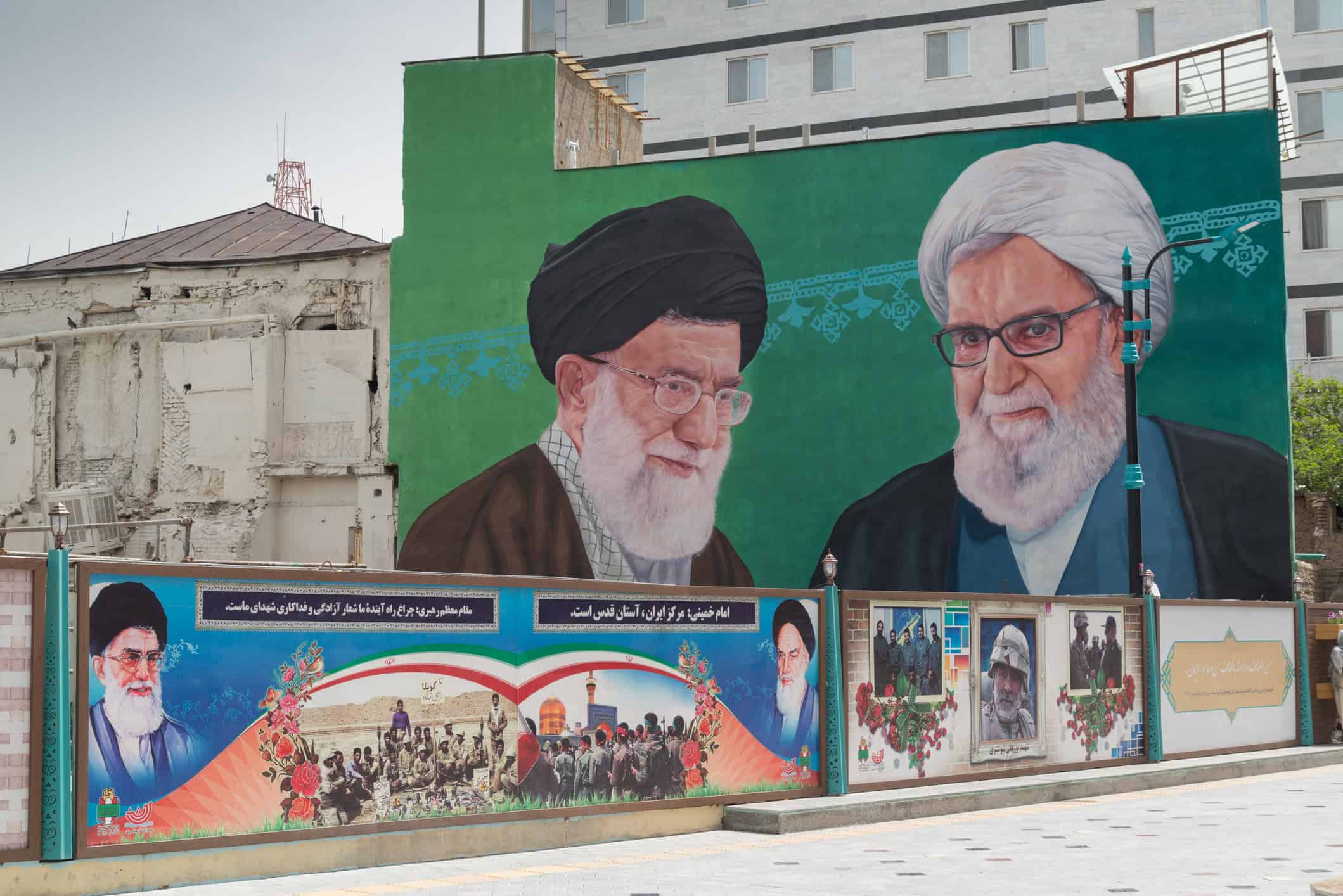
As the United States executed decisive strikes to dismantle Iran’s nuclear facilities at Fordow, Natanz, and Isfahan during Operation “Midnight Hammer,” and Israel secured control of Iranian airspace within a mere four days, one question dominated media discourse: would these measures prove to be the decisive blows that lead to the collapse of the Islamic Revolutionary Guard Corps (IRGC) and bring an end to a forty-six-year reign of brutal theocratic rule? As often in history, time has granted its verdict: two months later, the regime endures. Yet the very posing of the question – whether the Iranian theocracy will collapse – remains telling, for it both reflects the West’s anticipation of the Ayatollahs’ waning grip on power and compels us to examine what will bring their downfall.
To address this question, it is useful to look at the collapse of the Soviet Empire, as both Iran and the Soviet Union were and are governed by totalitarian systems. What leads to the downfall of such regimes? In the case of the Third Reich, for instance, external forces, specifically the military defeat of Nazi Germany in World War II, brought about the dismantling of Hitler’s regime. It is possible that the architects of “Midnight Hammer” were likewise counting on it to ignite a larger conflict. But this did not happen. Option two – internal factors – points us to the collapse of the Soviet Union.
Indeed, volumes of scholarship have been devoted to examining what precipitated the downfall of America’s most formidable adversary: the Soviet Empire. Historians generally fall into two camps. One view holds that the Soviet Union’s downfall was sudden and unintended, the result of elite miscalculations and deep structural weaknesses. The other emphasizes Mikhail Gorbachev’s reforms, glasnost and perestroika, as destabilizing the entrenched framework of the Soviet system. While the collapse can indeed be traced to a weakening center, its leading causes may be found in two pivotal events that seldom receive the attention they should: the Soviet Jewry movement and the Chernobyl disaster.
Though vastly different, both exposed the regime’s deeper vulnerability – its inability to control their core narrative to the West. For any totalitarian regime, such narrative control is essential to survival. Essential to combating totalitarianism is to correctly identify their core narrative. Indeed, as American political scientist Gene Sharp observes, absolute power is based on pillars of support. These pillars are sources of the government’s power and if they “can be identified, then its weak points can be recognized, the government will lose its power” (From Dictatorship to Democracy, 1993). While a Kremlinologist might divide the narrative into distinct eras, Leninism, Stalinism, the Thaw, Brezhnev’s Stagnation, and Gorbachev’s liberal reforms, broadly speaking, during the Cold War the Soviet Union sought to project itself as the best country on earth, a social utopia born of the Bolshevik Revolution and sustained by Marxist ideology. Paradoxically, the Soviet Union’s “paradise-on-earth” narrative was undermined by the plight of its Jewish population, a reality Americans recognized and deftly used to expose the false image the Soviets projected to the world.
The plight of Soviet Jewry began in the immediate postwar years, when Stalin unleashed the Doctor’s Plot, a vehement campaign built on the libel that Jewish doctors were secretly plotting to poison top Kremlin leaders. This campaign was accompanied by the forcible shutdown of the Jewish Anti-Fascist Committee (JAFC), which had been an instrumental arm of the Soviet war effort against the Nazis, and carried out state-ordered murders of Jewish poets, actors, and journalists. Despite Lenin’s and Bolshevism’s promises of granting Jews full equality and entry into society, the Soviet Union ultimately became one of the deadliest and most dangerous places for Jews after the Holocaust.
When confronted by Western journalists who repeatedly inquired about the condition of Jews in the Soviet “utopia,” Soviet leader Nikita Khrushchev famously addressed the matter in a speech to party and government officials on March 10, 1963 alongside writers and artists. Responding to accusations that Jews in the Soviet Union faced discrimination, particularly in light of the official policy denying that Jews were the primary victims at Babi Yar, Khrushchev emphatically declared, “We do not have a Jewish question, and those who dream it up are singing a foreign tune.” Broadly speaking, the “Jewish question” refers to writings by non-Jews that addressed the perceived problem of integrating Jews into their countries and determining their subsequent treatment.
Originating in Western Europe during the French Emancipation, discourse on the “Jewish question” ranged from neutral proposals for integrating Jews into host societies to openly hostile rhetoric, ultimately culminating in the Nazi “Final Solution to the Jewish Question,” a euphemism for the plan to annihilate the Jewish people. By announcing that the Soviet Union does “not have a ‘Jewish question,’” Khrushchev was rejecting that Jews were being mistreated in the communist utopia. This is significant because you cannot claim to have created a paradise if you have accusations of human rights violations. History, of course, tells a very different story. Mass migration of the Jews from the former Soviet Union (FSU) has a history of about half a century. Based on the collected data, it was estimated that since 1970 almost two million Jews and their relatives left the former USSR. This emigration led to dramatic shrinkage in the size of the Jewish population remaining, as well as resettlement of ex-Soviet Jews mainly in the three destination countries – Israel, the US, and Germany.
The mass exodus of Jews from the Soviet Union is a story of discrimination. Forbidden from practicing their religion and cultivating their cultural traditions, Soviet Jews were punished for any expression of Jewish nationalism. It is for this reason that antizionism was crafted in the Soviet Union as a response to Jewish nationalism, which is what Zionism is. For the “crime” of Zionism (i.e. Jewish peoplehood), Jewish families in the Soviet Union were denied exit visas, lost jobs and effectively became social pariahs.
Significantly, because the refusenik movement took on a life of its own, the Soviets could no longer control the narrative, namely that the Soviet Union is the best system that man could create. The loss of control over the narrative can be seen in the historic Jackson-Vanik Amendment to the Trade Act of 1974, which was instrumental in eliminating barriers to the emigration of Soviet Jewry. Enforcing non-market economies to comply by allowing people to emigrate in exchange for receiving economy benefits in trade relations with the United States, the Kremlin, of course, saw this Trade Act as an egregious intervention in domestic affairs. It complied nonetheless due to economic pressure. Linking trade benefits to Soviet Jewish emigration in hindsight, was genius as it was one of the first screws to loosen and ultimately unravel the Soviet utopian project.
Led by grassroots organizations and Jewish leaders, the Soviet Jewry movement gained momentum and played a significant role in détente, the period of eased tensions and improved relations between the U.S. and the Soviet Union. The plight of Soviet Jews exposed to the world the hypocrisy of the so-called Soviet utopia, captured in the phrase “a Jew is a mode of transportation.” Popularized in the 1970s, this phrase referred to the fact that many Soviet non-Jews sought to marry Jews, since Jews were often the only minority group permitted to emigrate at certain times. This revealed that the desire to escape the rotten system was not limited to Jews but shared widely across Soviet society.
By denying Jewish rights, the Soviets found themselves at the center of a global drama shaped by the 1975 Helsinki Final Act. That agreement empowered dissidents, including but not limited to Jewish refuseniks, and created transnational monitoring networks the Kremlin could no longer easily suppress. Within this context, the Soviet Jewry movement was not an isolated struggle but part of the broader “Helsinki effect,” a force that steadily weakened communist rule from within. In short, the collapse of the Soviet Empire, reflected in the mass exodus of Soviet Jewry, places the refusenik movement at the heart of the Soviet Union’s downfall.
Like the Soviet Jewry which revealed what was behind the mask of the Soviet Union, namely a system that violated human rights and not respected them, the 1986 Chernobyl crisis exposed the ineptitude of Soviets to the world and perhaps even more bitterly, to themselves. When the nuclear reactor at Chernobyl exploded on April 26, 1986, it was officially presented as a localized “incident,” quickly contained and under control. In reality, it was the most serious nuclear disaster in history.
For Mikhail Gorbachev, the last leader of the Soviet Union, it would become a turning point, one that he later called “perhaps the real cause of the Soviet Union’s collapse five years later.” Gorbachev wrote that “the nuclear meltdown at Chernobyl 20 years ago this month, even more than my launch of perestroika, was perhaps the real cause of the Soviet Union’s collapse five years later.” In his memoirs, he described the disaster as “graphic evidence, not only of how obsolete our technology was, but also of the failure of the old system. At the same time … it severely affected our reforms by literally knocking the country off its tracks.”
Over time, Chernobyl eroded public confidence in the Soviet system and undermined glasnost’s intentions by revealing the regime’s inability to be transparent or responsible. Gorbachev viewed Chernobyl as a catalyst that exposed the Soviet system’s technological decay, systemic inefficiency, and lack of openness. Like the human rights crisis of Soviet’s Jewry, the Chernobyl crisis accelerated the disintegration of the Soviet Union and revealed the weak position that the Soviets were in because its leaders were unable to maintain control over its image on the world stage.
What lessons, then, do these two events offer for anticipating the fall of the Iranian regime? Would it take a similarly oppressed group whose violated human rights incur a mass exodus, exposing Iran as no sacrosanct state? Or a catastrophic nuclear disaster that brings public shame to the Ayatollahs? Here time has delivered its verdict. The 2009 Green Revolution in Iran, could have been a pivotal moment to rally the world around the largest protest since the 1979 Islamic Revolution, but it ultimately failed. Millions of Iranians, holding signs and chanting “Where is my vote?” flooded the streets to demand new elections and denounce the regime for rigging the vote. Significantly, it showed that many Iranians were willing to risk their lives for change.
For all intents and purposes, it had similar ingredients to the Soviet Jewry crisis. Why did it not produce similar results? Many political analysts attribute America’s lackluster support for the Iranian opposition to President Obama’s reticence and his broader policy of “leading from behind,” a policy that has proven to be a complete failure. Critical world events require several factors to align, and one of these is a leader willing to act decisively. Because Obama was no Ronald Reagan, a key ingredient was missing in 2009, which might have accelerated the collapse of the Islamic Iranian regime.
Yet, two months since the recent operation “Midnight Hammer,” the Ayatollah still reigns supreme. Unlike the defeat of Nazi Germany, military force has not hastened the downfall of the Islamic Revolutionary Guard Corps (IRGC). To be sure, “Midnight Hammer” was no sweeping, multipronged assault by Allied powers that could bring about the collapse of the Islamic regime. And since the world is either not ready or willing to wage an all-out war, we must seek alternative methods. How then shall we destabilize their narrative? If the Soviet narrative of “paradise on earth” was eroded by the phenomenon of a human rights crisis, then dismantling Iran requires correctly identifying and confronting the narrative at its core.
When it comes to reading Iran’s tea leaves, the more than 696 days of war forced upon Israel by Iran’s proxy, Hamas, suggest that Tehran is in a weakened position. Having armed, trained, and ideologically fueled its proxies in Gaza, southern Lebanon, and Yemen, Iran has now seen Israel swiftly dismantle Hezbollah in Lebanon and devastate Hamas in Gaza. The result exposes that the head of the octopus – Iran – may not be the stealthy powerhouse it projects itself to be. Furthermore, the swift unseating of the Assad regime in Syria, which had been bolstered by Iran and Russia proved that neither Iran nor Russia, could hold the fort.
What, then, is the narrative core to Iran’s ideology since the Islamic Revolution of 1979? To understand the Islamic regime today requires taking off western lenses that privileges minority and free speech rights. Unlike the Soviets, Iran is not concerned with projecting an anti-colonial, best-place-on-earth status. What Iran’s nature and ideology reveals is a difficult narrative to undercut namely because it falls totally outside of western notions of progress, state-building, and civility.
In May 2022, Saeid Golkar and Kasra Aarabi published a report detailing the ideological underpinnings of the Islamic regime. They revealed the Islamic regime is not vying for who gets to space first, but is deeply rooted in eschatology: who will hasten the apocalypse for the salvation of humanity and establish the final reign of peace and justice. As explained by the Middle East Forum, “the Muslim doctrine of Mahdism revolves around an eschatological figure – the Mahdi, or ‘Rightly Guided One’ – who vanquishes evil and ushers in Islamic rule during the end times.
Both Sunnis and Shias believe in the Mahdi, though they have different versions of his exact nature and role. Significantly, Mahdism is bolstered by the IRGC, “which, as described by Iran’s 1979 Constitution, is an ‘ideological army,’ mandated with an “ideological mission of jihad in Allah’s way.” The IRGC, which is an umbrella of Islamic militias and was instrumental in consolidating power in post-revolutionary Iran, thus fulfills a central role in preserving this ideology.
The IRGC acted as the clergy’s vanguard against the waves of liberalization that began to enter Iranian society in the late 1990s and early 2000s. During the failed Green Revolution, it further expanded its role in intelligence, particularly during the fraudulent 2009 elections that sparked the Green Movement. What remains clear is that in Iran’s medieval theological framework, shaped by Mahdism, liberalism is forbidden because it poses a direct threat. Recognizing this tension is key to accelerating the unraveling of the Islamic regime.
It seems that the West has two options if it hopes to bring about the demise of the IRGC. The first is to support a growing opposition movement that seeks to introduce liberal policies. If the collapse of the Soviet Empire offers any lesson, it is that Gorbachev’s liberal reforms in the 1980s hastened the downfall of the USSR, since totalitarian regimes are fundamentally incompatible with liberalism. Should this path be pursued, it may give rise to a beleaguered group of Iranians demanding human rights. Could they become the Soviet Jewish doppelganger that undermines Iran’s eschatological narrative?
The second option is far more difficult, because it requires “turning back the clock” to the medieval crusades of 700–900 years ago. This is due to the Ayatollahs’ eschatological vision of salvation. As mandated in Iran’s 1979 Islamic constitution, the state’s mission is “the ideological mission of jihad in God’s way; that is extending sovereignty of God’s law throughout the world.” The word “sovereignty” is key as it shows that, for Iran, current political borders are not an end in themselves but a means to advance global jihad. In this framework, salvation depends on exporting jihad.
The challenge in confronting this ideology is not the absence of a time machine, but the fact that “going medieval” requires military confrontation. America and the West, however, may not be ready, or willing, to engage in such a conflict. A more relevant model may be the 2011 Arab Spring, when Egyptian dictator Hosni Mubarak was forced from power. After student-led demonstrations sparked nationwide protests, tens of millions of Egyptians demanded the resignation of a president who had ruled for 30 years. Crucially, Mubarak lost control of his armed forces, and it was the Egyptian military’s decision to turn against him that sealed his fate.
The Arab Spring offers many lessons, but one is especially relevant for confronting the Ayatollahs: supporting Iranian dissidents must go hand in hand with efforts to weaken the regime’s ties to the Iranian Revolutionary Guards. What is clear, whether we look at the factors that hastened the collapse of the Soviet Union or the uprising in Egypt, is that accelerating the downfall of Iran’s Islamic regime requires a deep understanding of its nature, ideology, and core narrative, and opposing it on its own terms, not ours.
This monthly series is presented by George Violin

Naya Lekht received her PhD in Russian Literature from UCLA, where she wrote her dissertation on Holocaust literature in the Soviet Union. A passionate educator and curriculum developer at the collegiate and high school levels, Naya has taught courses on the history of antisemitism, the Arab-Israeli conflict, and Soviet history and literature. She is a regular contributor to the Jewish Journal and is a columnist at The Jerusalem Post. In addition to writing and speaking on contemporary antisemitism, Naya is a Research Fellow at the Institute for the for the Study of Global Antisemitism and Policy.